Inogen Portable Oxygen Concentrators: Devices and Pricing

Price Disclaimer: All price ranges reflect publicly available MSRP data as of early 2026 and are provided for informational comparison only. Actual prices vary by retailer, promotional discounts, and date of purchase. Always verify current pricing directly with the supplier before making a decision.
Your doctor has prescribed supplemental oxygen, but you’re not sure where to start. Oxygen tanks may have lower up-front costs and come in smaller sizes, but oxygen concentrators don’t need to be refilled, are less flammable, and can be used for up to 12 hours. Of course, there’s a higher initial cost, but they’ll be cheaper in the short-term, as oxygen concentrators can last an estimated four to seven years.1
U.S.-based Inogen revolutionized older adult respiratory care in 2001 with the introduction of the first-ever portable oxygen concentrator that did not require refills. Instead, the machine purified oxygen from its surrounding environment, eliminating the need for bulky oxygen tanks. More than 20 years later, Inogen continues to give people who use oxygen therapy the confidence, freedom, and independence to lead active lifestyles.
In this rundown, I’ll provide a thorough overview of Inogen, including its systems, how they function, what they cost, and their overall value. Let’s take a closer look.
New to the world of portable oxygen concentrators? Check out my guide to portable oxygen concentrators to learn how the technology works and how much they cost.
My Favorite Portable Oxygen Retailer
As an experienced caregiver, I trust the Oxygen Concentrator Store because they offer a wide selection of portable oxygen concentrators, making it easy to find the perfect match for my patients’ needs, and their knowledgeable customer service team is always ready to provide guidance and answer my questions. This combination of expert support and variety ensures I can make the best choices for those in my care, while their competitive pricing and reliable delivery options give me peace of mind. Together, these qualities make them my favorite resource for dependable oxygen solutions.

Inogen Products and Pricing
As of 2026, Inogen sells three oxygen concentrators, two portable ones and one stationary model. The concentrators range in price from about $1,700 to $2,800. In addition to the individual oxygenators, there are also what the company calls Freedom Bundles, which combine a home concentrator and portable concentrator for $4,370 to $5,395, depending on the model and warranty term you choose.
Inogen System Pricing
Here are the prices of individual concentrators, if you’re interested in either a home or a portable concentrator but not both.
| System | Inogen Rove 4 | Inogen Rove 6 | Inogen At Home |
|---|---|---|---|
| Base unit price | $2,695 | $2,795 | $1,695 |
| Portable | Yes | Yes | No |
| Maximum oxygen flow time* | Up to 6 hours | 12 hours, 45 minutes | Unlimited |
| Expected service life | 8 years | 8 years | Not listed |
| Decibel level (on setting 2) | 39 | 39 | 45 |
*refers to maximum flow time with double battery
Currently, the Inogen At Home comes with a three-year warranty but not a lifetime warranty. With the Rove 4 and Rove 6, however, you can choose a warranty length that determines your total price. See the chart below for pricing for each warranty. (Note: Pricing subject to change.)
| Device | Warranty | Price |
|---|---|---|
| Inogen Rove 4 | 3-year warranty | $2,915 |
| Inogen Rove 4 | Lifetime warranty | $3,470 |
| Inogen Rove 6 | 3-year warranty | $2,795 |
| Inogen Rove 6 | Lifetime warranty | $3,600 |
| Inogen At Home | 3-year warranty only | $1,695 |
Pro Tip: For information on general pricing for portable oxygen concentrators, check out our in-depth guide.
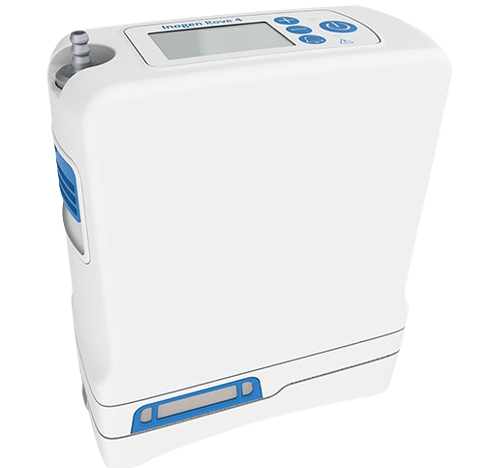
Inogen Rove 4
Designed and assembled in the U.S., the Rove 4 is just under 3 pounds and provides users with supplemental oxygen for up to six hours. Choose from three battery options — standard, intermediate, and extended. At flow setting 1, the Rove 4’s battery lasts up to three hours and 12 minutes, and the extended battery lasts up to a little over six hours at flow setting 1.
The device is quiet at only 39 decibels at flow level 2, and it’s FAA-approved for air travel. The Rove 4 has four pulse dose delivery settings and comes with a DC power cable, AC power supply, battery, user’s manual, and a carry bag.
>> You might like: What Is Home Health Care and How Can It Help You Age in Place?
Currently, the Rove 4 is available at a lower price than Inogen’s previous C4 system, which only had three oxygen flow settings. We also like that the Rove 4’s screen is easy to read and its functions are intuitive. The accompanying Bluetooth mobile app, Inogen Connect, helps users stay active while monitoring their oxygen usage and battery life.
It’s important to note that the Rove 4 likely is not appropriate for users who need a continuous flow of oxygen, and that its maximum output is 840 mL of oxygen per minute. This device provides pulse-dose delivery meant for portable use, so it’s perfect for someone with lower supplemental oxygen needs to feel more confident while out and about.
Inogen Rove 6
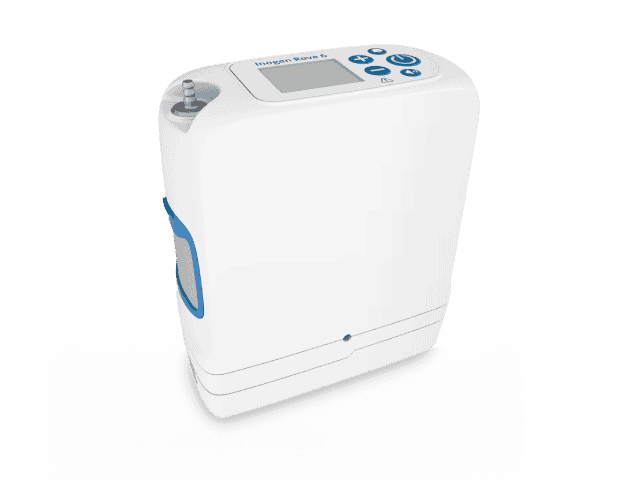
A little heftier at nearly 5 pounds, the Rove 6 is also FAA-approved for air travel and its powerful battery lasts up to nearly 13 hours, about twice as long as the battery life of the Rove 4. As with the warranty length, you can choose between a standard and an extended battery option, which affects the concentrator's price. As its product name implies, the Rove 6 offers six pulse settings.
Like the Rove 4, it has a bright LCD screen that’s easy to read and is quiet at 39 decibels. Unlike the Rove 4, the Rove 6 comes with two battery options compared with the three offered with the Rove 4.
FYI: How loud is 39 decibels? Here are other sounds that are typically 39 decibels: the hum of a modern refrigerator, distant rain, and quiet office settings. Learn more at the website of the Hearing Health Foundation.2
The Rove 6 can deliver more oxygen per minute than the Rove 4. Consequently, it’s more appropriate for people with higher oxygen needs while allowing them to stay active and travel. While Rove 6 can deliver 1,260 mL of oxygen per minute, note that it’s still meant for portable use and does not deliver a continuous flow of oxygen.
This oxygen concentrator model is best for people whose oxygen needs exceed a device with only four flow settings and who can handle carrying a 5-pound bag around town. Be aware that while the Rove 6 can help preserve people’s mobility and improve quality of life, the device isn’t appropriate for people who need continuous oxygen. The Rove 6 delivers oxygen only when you inhale.
Inogen at Home
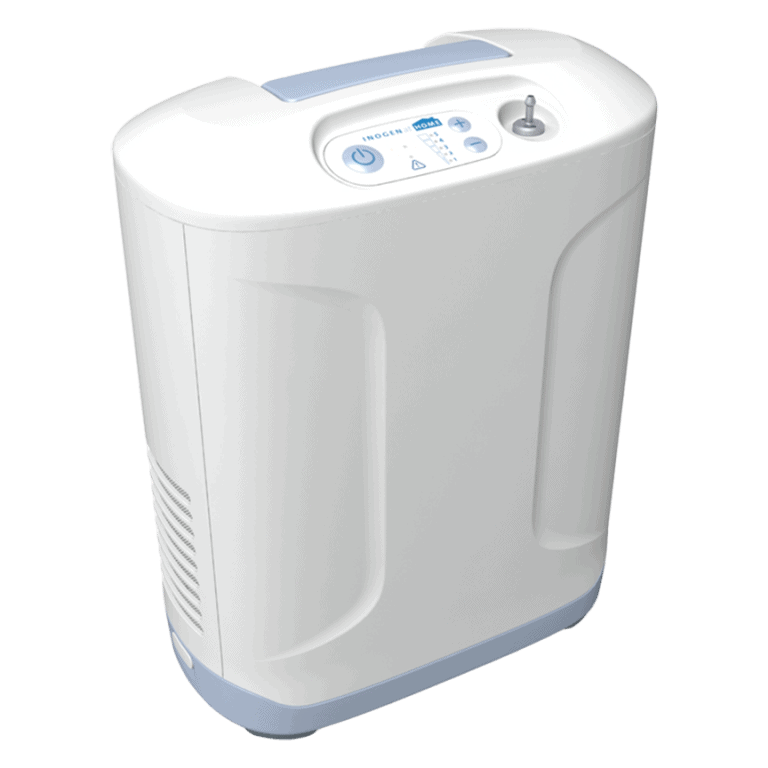
Rather than providing pulses of oxygen like Inogen’s other concentrators, Inogen At Home provides five liters of continuous oxygen. The ultra-quiet system is one of the most energy-efficient oxygen concentrators on the market, according to the company. They also provide an energy calculator on their website so you can calculate your actual daily and monthly energy costs.3
Did You Know? A recent study found that common durable medical equipment (DME) can increase a household’s monthly energy bill by 40 percent, and that people who rely on DMEs such as oxygen concentrators might pay an additional $120 to $700 more per year in electricity costs.4
Most at-home oxygen concentrators weigh about 40 pounds, but Inogen At Home comes in at less than half of that at 18 pounds. It's designed for stationary use, but many people move their oxygen equipment around their homes. I couldn’t easily move a 40-pound concentrator, but an 18-pound device is much more manageable. With five flow settings and the capability to deliver medical-grade oxygen at a concentration of 87 percent to 96 percent, the Inogen at Home system can accommodate changes in your condition, circumstances, or prescription.
Purchasing From Inogen
You can purchase an Inogen oxygen therapy system on the company’s website or call their sales line at 855-694-6643. Buying online is faster, but speaking to a customer care agent on the phone is a great way to get expert input and customize your purchase. Given Inogen’s return policy, you’ll probably want to buy everything during one purchase.
Supplemental oxygen of any kind requires a prescription from a doctor. Make sure you’ve received a prescription and discussed your needs with your medical provider before beginning your search for a portable oxygen concentrator. Once you place your order, you’ll receive a call from an Inogen specialist, who will record your prescription information.
Because they’re considered durable medical equipment (DME), rentals of most of Inogen’s portable oxygen concentrators are covered by Medicare. In fact, according to Avalere Health Advisory research published in 2023, oxygen concentrators account for nearly 10 percent of the $8 billion Medicare spent on DME in 2021.5
Related Reading: To learn more about renting portable oxygen concentrators, read our guide on Portable Oxygen Concentrator Rentals.
Setting up Your Inogen System
Setup for Inogen concentrators is easy and requires no additional tools or expertise. Inogen provides step-by-step setup videos for each of its systems in the Support section of its website. The following instructions are for the Rove 4 system, but setup for the other concentrators is very similar.
Inogen Setup Process
- Choose a well-ventilated location to use the concentrator in.
- Install the battery by aligning it with the device’s bottom housing and sliding it into place. You should hear a click and the latch should be in an upright position. Then you’ll hear a single beep and the indicator lights should flash once, meaning you have connected the device successfully. Note: Do not use a battery not listed in Inogen’s manual for this product.6
- Plug the AC input cable into the power supply brick, then plug the AC power plug into the wall outlet. Plug the power outlet plug into the device. Again, you’ll hear a single beep and see a flash of indicator lights and the display screen before it switches off again. That indicates that you’ve connected the power supply correctly.
- Connect a cannula tube by inserting it into the metal cannula barb near the top of the device. Using a single lumen cannula up to 25 feet (7.62 meters) in length is recommended.
- Press the ON/OFF button and check the battery level and flow setting before using the concentrator. If the device turns off immediately after pressing the button, you might need to hold the button down a bit longer.
FYI: Don’t consume alcohol or take medication that relaxes you while using supplemental oxygen because it can slow your breathing to dangerous levels, warns the Kaiser Foundation Health Plan.7
Inogen Returns and Warranties
Inogen offers a 30-day trial period after the purchase of an oxygen therapy system. If you are dissatisfied with your product, you may return it for a refund after you’ve completed an equipment return form (available on Inogen’s website) and sent your equipment back. You can also complete most of your return information over the phone.
If you contact the company within 30 days from the date of delivery and return it within seven days of the start of the return process, you’ll receive a full credit for the product price. However, if you miss that seven-day window, you’ll have to pay a $400 restocking fee, and no returns are accepted after 30 days of the delivery date.
Inogen Warranties
As mentioned, all Inogen machines include a three-year or a lifetime warranty (Note again that lifetime warranties cost more.) These nontransferable warranties guarantee that, within the agreed upon period of coverage, your product is warranted to be free of defects “in materials and workmanship under normal use and service” according to the company.
The Bottom Line
Inogen’s portable oxygen concentrators allow oxygen therapy patients to enjoy active and on-the-go lifestyles that were, until recent years, impeded by their need for constant oxygen and heavy refill tanks they had to lug around.
I’m more of a discount kind of gal, and, unless you have Medicare or insurance to cover your oxygen therapy, Inogen’s systems and accessories can cost a pretty penny. I like that Inogen’s systems provide freedom once thought to be impossible for patients on supplemental oxygen. Inogen may not be the financially smart answer for oxygen therapy if you rarely leave your home, but if you want to keep living life to its fullest inside, outside, and around your home, the company’s portable oxygen concentrators are a solid solution.
For more information that may be relevant to you, check out the following guides:
Our Methodology: How We Evaluate Inogen Portable Oxygenators
Oxygen concentrators are medical equipment requiring a doctor’s prescription for supplemental oxygen. Your doctor likely will recommend devices based upon your needs and insurance, but here are some important factors we considered when evaluating Inogen’s portable oxygenators:
- Purity of the oxygen: The oxygen should be between 87 and 99 percent concentration.
- Flow rate: The flow rate should be around two liters per minute, but it can go as high as 10 liters per minute.
- Size: Particularly with portable concentrators, make sure the device is light enough for you to carry.
- Battery life: Again, because battery life is an issue with portable concentrators, look for devices with batteries that, ideally, last eight hours or more.
- FAA and FDA approval: The device should be approved for air travel by the Federal Aviation Administration (FAA) and approved for safety by the Food and Drug Administration (FDA).
- Noise level: You don’t want a device that makes a ton of noise. Look for something with a noise level around 37 decibels.
- Safety features: The device should have indicators that alert you about low oxygen levels, power loss, flow rate, and purity of oxygen.
- Warranty: Ideally, the company offers lifetime warranties.
- Cost: Most oxygen concentrators will cost thousands, but often, you can get them covered by Medicare or private insurance, as long as you get a doctor’s prescription.
Pro Tip: If you plan on traveling with your POC, you’ll find our guide helpful.
Frequently Asked Questions
-
Are Inogen portable oxygen concentrators safe for commercial air flight?
Yes, both the Rove 4 and the Rove 6 portable oxygen concentrators from Inongen are approved by the Federal Aviation Administration (FAA) for use on commercial air flights.
-
Will Medicare pay for Inogen?
The short answer is yes, with some caveats. If you medically qualify, Medicare will pay for the rental of an Inogen oxygen concentrator, after you pay your Medicare Part B deductible, for three years. Medicare typically pays 80 percent of these costs, and you pay 20 percent. Some supplemental insurance policies might cover those out-of-pocket costs, however.
-
What is the average cost of an Inogen?
Inogen oxygen concentrators cost between $1,700 and $3,600. Portable concentrators generally are more expensive than at-home concentrators.
-
How will my Inogen machine react to hot or cold environments?
When using your Inogen machine, it’s wise to stay inside if outdoor temperatures are higher than 90 degrees or below freezing. In hot weather, your system can overheat and damage its batteries. Cold, snowy environments also can potentially harm your device, as they’re not waterproof.
-
How do I maintain my Inogen oxygen concentrator?
Your oxygen concentrator requires regular maintenance in a variety of areas, including batteries, nasal mask, case, and particle filters. For specific instructions, refer to your user manual.