How to Travel Safely With a Portable Oxygen Concentrator
 |
June 11, 2026
|
|
June 11, 2026
|
Needing supplemental oxygen doesn't mean giving up on travel — it just means you’ll need a travel-ready portable oxygen concentrator (POC) and to keep a few extra preparations in mind.
Portable oxygen concentrators can make a huge difference for more than a million Americans who use supplemental oxygen therapy in an outpatient setting.1 POC models are designed to be lightweight and to help people maintain more social, active, and independent lives. And a big part of that is being able to travel.
In this guide, we’ll cover what you need to know about traveling with a portable oxygen concentrator, including our top travel-ready POCs, how battery requirements work, what to tell your airline, and how to stay comfortable, confident, and prepared.
Tip: Before Booking Your Trip, confirm with your doctor that travel is safe given your current health status and oxygen prescription.
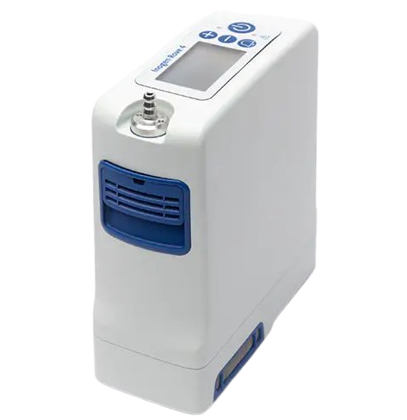
Further reading: Want to learn about Inogen, one of our top recommended POCs? Read our guide to Inogen Portable Oxygen Concentrators.
Air Travel With a Portable Oxygen Concentrator
If you currently use a standard home (stationary) oxygen concentrator or tank, it's important to know that compressed and liquid oxygen cylinders are prohibited on commercial aircraft (in the cabin and as checked baggage) because pressurized oxygen cylinders pose a fire and explosion risk. This applies to all U.S. flights and foreign airlines operating flights to or from the United States.
POCs are the only personal oxygen equipment permitted on commercial flights. Unlike tanks, POCs don't store compressed oxygen; instead, they draw in cabin air and concentrate the oxygen in real time, making them safe for in-flight use.
FYI: Airlines are not required to provide onboard oxygen. As of 2025, nearly all major U.S. carriers no longer offer in-flight oxygen service, meaning that you are responsible for bringing your own FAA-approved POC.
How to Prepare for a Flight With a Portable Oxygen Concentrator
Preparation is what separates a smooth travel experience from an avoidable problem at the gate. Follow these steps in order, starting well before your departure date.
1. Confirm your device is FAA-approved.
Locate the red compliance label on your unit. If you're renting a POC for travel, verify FAA approval2 with the rental company before the unit ships to you.
To verify that your device is FAA-approved, look for a red-text label on the exterior of the unit. The label must state: “The manufacturer of this POC has determined this device conforms to all applicable FAA acceptance criteria for POC carriage and use on board aircraft.”
If your unit has this label, it is cleared for use on all U.S. commercial flights and foreign flights to and from the U.S. without any additional approval process.
FYI: Your POC qualifies as an assistive medical device and does not count toward your carry-on baggage allowance, and no additional airline fee should be charged.
2. Notify your airline at least 48–72 hours in advance.
Most major U.S. airlines require advance notice that you will be using a POC onboard. You can notify your airline online through the airline's accessibility or medical equipment form, or by calling the airline's accessibility desk.
3. Obtain a physician's letter.
Airlines typically request a signed letter from your doctor confirming your oxygen prescription, the flow setting you require, your ability to self-manage your device and respond to alarms, and whether you need oxygen throughout the flight or only during specific phases.
Related reading: Best Medical Alert Systems of 2026 – See What Our Experts Found
4. Calculate your battery requirement.
The FAA requires that you carry enough battery capacity to power your POC for at least 150 percent of your total expected travel time.
Travel time includes boarding and pre-departure time, the flight itself, any layovers or connections, deplaning, and a reasonable buffer for delays. For example, if your total travel day is eight hours, including a two-hour layover, the FAA's 150 percent rule means you need at least 12 hours of battery capacity available at your prescribed flow setting.
Battery capacity also varies significantly by flow setting. A unit that provides 13 hours of runtime at setting 1 may only last six to seven hours at setting 3 or 4. Always calculate battery life at your prescribed setting, not the device's maximum quoted runtime, which is typically tested at the lowest flow.
5. Prepare Your Batteries for Travel
Three more rules govern how batteries must be handled on flights:
- All spare batteries must be carried in your carry-on baggage.
- Battery terminals must be covered or taped to prevent short circuits from contact with metal objects.
- Only non-spillable batteries are permitted in the cabin; standard lithium-ion POC batteries qualify, but confirm with your airline if you are uncertain.
To calculate exactly how many batteries you need, divide your required total battery time (flight + layovers + buffer, multiplied by 1.5) by your specific device's runtime at your prescribed flow setting. Then round up. It's always better to arrive with batteries to spare than to run short in the air.
6. Know your seating restrictions.
Passengers using a POC may not sit in an exit row. Request a seat assignment that allows floor or underseat storage for your device.
7. Bring documentation.
Carry a copy of your prescription, your physician's letter, and a copy of the FAA compliance statement for your specific device model. This helps if the airline staff has questions about your equipment.
Helpful Resource: To learn more, view our guide to POC purchasing options, as well as our guide on Medicare coverage of POCs.
Road Trips, Train Rides, and Cruises With a Portable Oxygen Concentrator
Air travel gets the most attention, but what if you’re planning another mode of travel?
Road Trips With a Portable Oxygen Concentrator
On road trips, most POCs can be powered using a DC car adapter, allowing continuous use without draining the battery. This is particularly useful for long driving days.
Confirm your device includes a DC power cable or purchase one compatible with your model before departure. At stops along the route, the AC adapter allows recharging at hotels or rest areas.
Train Rides With a Portable Oxygen Concentrator
Train travel is often one of the easiest ways to travel with a portable oxygen concentrator. Most major passenger rail services allow approved POCs on board without air travel’s strict battery regulations. Riders can typically use their concentrator throughout the journey as long as the device fits safely within the seating area and does not block aisles or exits.
For longer train rides, bring enough battery power to cover the trip in case power outlets are unavailable or temporarily inaccessible. While many trains offer outlets at seats, availability can vary. We recommend notifying the rail operator in advance if you need accessibility accommodations or extra assistance boarding with medical equipment.
Cruises With a Portable Oxygen Concentrator
Most major cruise lines can accommodate POC users well. Many ships offer accessible staterooms with additional outlet placement, and cruise lines typically require advance notice when you book.
Confirm power outlet types on international routes, as some ships use non-U.S. outlets and an adapter may be needed. Cruise lines do not follow FAA battery rules, but always bring adequate backup battery capacity.
Our Methodology
Our goal for evaluating portable oxygen concentrators for travel was to help readers understand which devices are best suited for flying, road trips, cruises, and other forms of travel while using supplemental oxygen therapy.
The Senior List editorial team reviewed current FAA regulations, TSA guidance, Department of Transportation accessibility rules, airline portable oxygen concentrator policies, and publicly available manufacturer specifications for FAA-approved devices. We also reviewed federal battery and safety requirements for in-flight oxygen use.
We compared each device across several factors that directly affect the travel experience and only included FDA-cleared, medical-grade portable oxygen concentrators from established manufacturers. We relied on publicly available MSRP pricing and authorized dealer information available in early 2026. Actual prices and battery bundle options may vary by retailer and promotional availability.
We also reviewed legal protections for travelers using portable oxygen concentrators under the Air Carrier Access Act, as well as Medicare limitations related to oxygen coverage during air travel. In addition, we consulted peer-reviewed medical literature and interviewed a healthcare expert to ensure clinical safety considerations and the practical realities of traveling with supplemental oxygen.
Lastly, we considered the real-world logistics of traveling with a portable oxygen concentrator — including battery planning, physician documentation, airline notification requirements, layovers, cruise accommodations, and backup power strategies — so readers can better prepare for safe, comfortable, and stress-free travel.
The Bottom Line
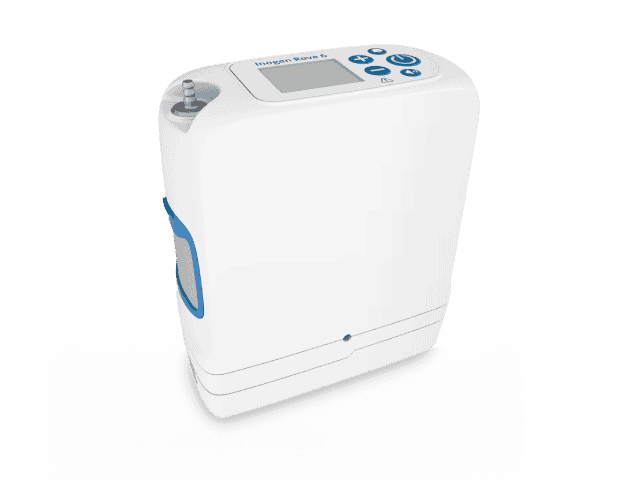
Traveling with supplemental oxygen requires more planning than a standard trip, but it's entirely achievable with travel-ready POCs, like the Inogen Rove 6, and a little extra preparation.
In addition to allowing yourself sufficient time, the other major factor in ensuring a smooth travel is choosing the right device for your prescription and itinerary. If traveling by air, notify your airline, get your physician's letter, calculate your battery needs using the 150% rule, and tape those spare battery terminals. For road trips, train rides, and cruises, get a DC car adapter and notify your travel line.
Frequently Asked Questions
-
Can I bring my portable oxygen concentrator on a plane?
Yes — under the Air Carrier Access Act, U.S. airlines are required by federal law to allow passengers to use FAA-approved POCs on flights with 19 or more seats, and airlines cannot charge you an additional fee for bringing your device. Foreign airlines operating flights to or from the U.S. are subject to the same requirement.
-
How do I know if my portable oxygen concentrator is FAA-approved?
Look for a red-text label on the exterior of the device stating the manufacturer has determined the unit meets FAA acceptance criteria for in-flight use. If this label is absent, the device is not permitted in the aircraft cabin regardless of the brand.
-
How much battery do I need for my flight?
The FAA requires battery capacity equal to at least 150% of your total travel time, which includes boarding, the flight, layovers, and a delay buffer — not just the scheduled flight duration. Always calculate at your prescribed flow setting, not the device’s maximum published runtime.
-
Do I need to tell the airline in advance that I'm bringing a POC?
Yes — most airlines require at least 48 hours’ advance notice and a physician’s letter confirming your oxygen prescription and your ability to manage the device independently. Failure to notify in advance does not invalidate your legal right to fly with a POC, but it may lead to delays and additional checks at the gate.
-
Will Medicare cover my portable oxygen concentrator for air travel?
No — Medicare explicitly excludes oxygen costs related to air travel and does not cover POC rentals or purchases for travel purposes. Short-term travel rentals are available from specialized companies, but these are fully out-of-pocket expenses.