CAIRE Oxygen Concentrators Review
 |
June 11, 2026
|
|
June 11, 2026
|
Price Disclaimer: All price ranges reflect publicly available MSRP data as of early 2026 and are provided for informational comparison only. Actual prices vary by retailer, promotional discounts, and date of purchase. Always verify current pricing directly with the supplier before making a decision.
CAIRE Inc. has been manufacturing medical oxygen equipment for more than 50 years, and its portable concentrator lineup reflects that depth of clinical experience in ways that newer brands to the market cannot easily replicate. CAIRE offers two primary portable oxygen concentrators for patients and caregivers: the FreeStyle Comfort, a lightweight pulse-dose unit built for all-day active wear, and the SeQual Eclipse 5, a cart-based unit offering both continuous flow and pulse-dose therapy for patients with higher or more complex oxygen requirements.
Together, these two devices cover a remarkably wide range of prescriptions. From a senior who’s newly been prescribed a pulse dose at setting 1, who wants to walk comfortably outdoors, to someone who requires up to 3 LPM of continuous flow oxygen and needs to travel across the country by road trip. That is CAIRE’s most significant strength as a brand.
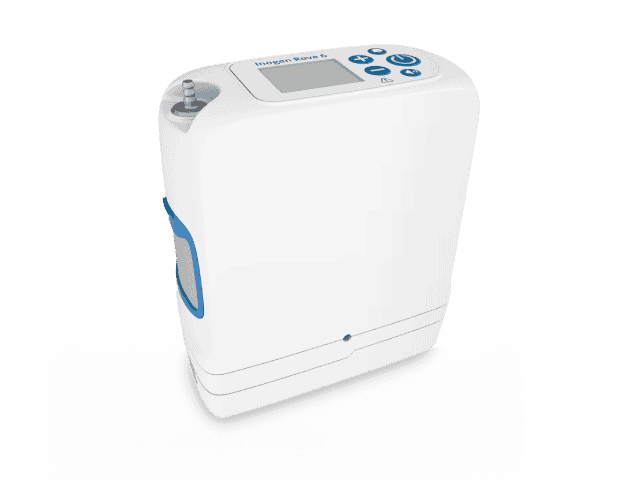
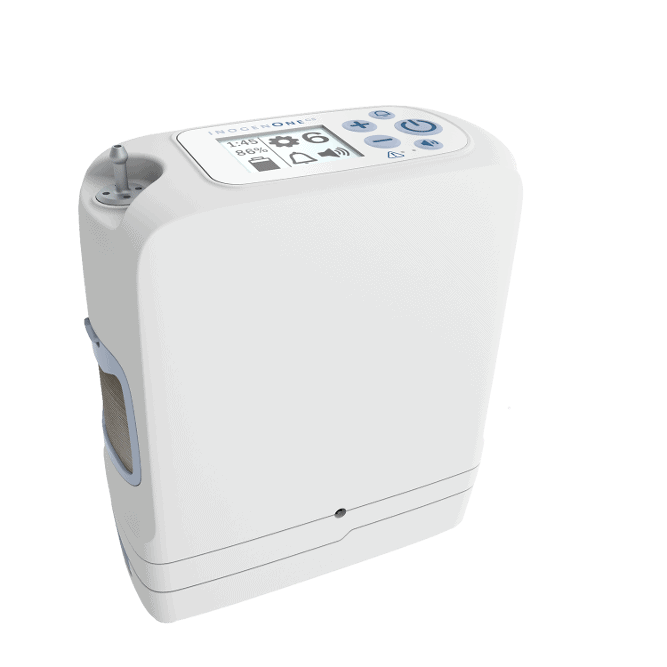
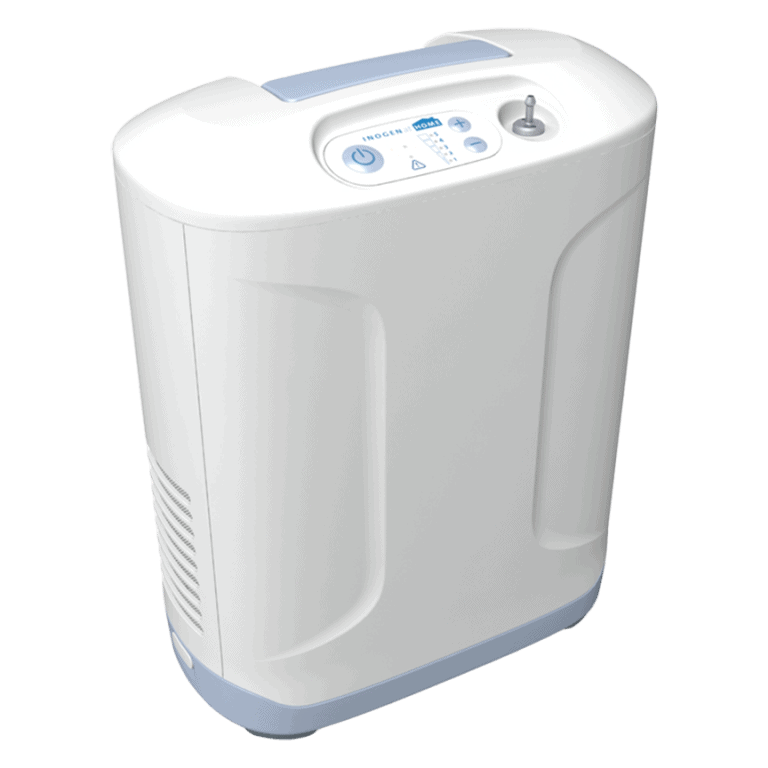
Our review ranges from specs, pricing, feature comparisons and warranty terms to a head-to-head comparison with Inogen’s Rove lineup.
Our Methodology
The Senior List editorial team evaluates portable oxygen concentrators through a framework of five primary criteria: clinical suitability across a realistic range of prescribed flow settings; sustained portability and wear comfort during extended daily activity; real-world battery performance at mid-range settings; accessibility and ease of use for older adults; and FAA approval status for travel viability.
Specifications are sourced directly from manufacturer product pages and cross-referenced with authorized dealer documentation. Pricing data is gathered from a range of authorized dealers and updated regularly; prices listed reflect typical retail ranges at the time of publication and may vary by channel and promotional timing. Medicare and insurance details reference current CMS guidance for the applicable benefit year.
We do not accept manufacturer payment for reviews, and our editorial assessments are independent of commercial relationships.
CAIRE at a Glance
CAIRE was the first oxygen concentrator manufacturer to include a 3-year warranty covering not just the device but also the sieve beds and the internal filters, which are the most maintenance-intensive components in any concentrator.1 See the table below for an overview of their specs.
Pro Tip: CAIRE does not sell directly to individual consumers. To purchase a FreeStyle Comfort or Eclipse 5, you’ll need to work through an authorized dealer or a home health equipment supplier.
Quick Specs
| Specification | CAIRE FreeStyle Comfort | CAIRE SeQual Eclipse 5 |
|---|---|---|
| Delivery mode | Pulse dose (settings 1-5) | Pulse dose (1-9) + continuous flow (0.5-3.0 LPM) |
| Weight | 5.0 lbs (8-cell) / 6.0 lbs (16-cell) | 18.4 lbs with battery and cart |
| Dimensions | 10.0 x 7.3 x 3.1 in (8-cell) | 19.3 x 12.3 x 7.1 in |
| Noise level | 39.9 dBA at setting 2 | 48 dBA at 3.0 LPM / 40 dBA at pulse 3 |
| Battery life | Up to 8 hrs (8-cell); up to 16 hrs (16-cell) at setting 1 | 5.4 hrs at pulse 2; 2.0 hrs at 2 LPM continuous |
| FAA approved | Yes | Yes |
| Companion app | Yes | Yes |
| Warranty | 3 yrs device + sieve beds; 1 yr battery | 3 yrs device + sieve beds; 1 yr battery |
| CPAP compatible | No (pulse dose only) | Yes (continuous flow supports CPAP) |
| Starting price (approx.) | $2,195-$2,749 | $2,300-$3,500 depending on package |
By the numbers: An estimated 1.5 million Americans use home oxygen therapy, and COPD, the most common underlying condition driving portable oxygen prescriptions, affects approximately 16 million adults in the U.S.1
Pros and Cons of CAIRE Freestyle Comfort
Pros
- Ergonomic design: The curved shell hugs the hip, reducing swing and bounce during walking, making it noticeably more comfortable than rectangular units worn on a shoulder strap for hours at a time.
- Flexible carrying options: Three carry configurations (shoulder strap, carry bag, or backpack) give users more flexibility than any Inogen Rove model.
- Long battery life: The 16-cell extended battery provides up to 16 hours of runtime at setting 1, the longest of any pulse dose unit in this weight class.
- Smart oxygen delivery: autoSAT and autoDOSE technologies automatically maintain oxygen delivery even when breath detection is temporarily absent.
- Industry-leading warranty: CAIRE was the first manufacturer to offer a 3-year warranty covering both the device and sieve beds.2
- Telehealth integration: The myCAIRE app shares usage data and flow settings with the senior’s care team in real time, enabling remote oversight of prescriptions.
- Accessible controls: A glow-in-the-dark keypad and large multi-color LCD display make the device easy to operate in any lighting condition.
Cons
- Heavier than some competitors: At 5.0 lbs, the FreeStyle Comfort is heavier than the Inogen Rove 4 (2.9 lbs) and slightly heavier than the Inogen Rove 6 (4.8 lbs).
- Pulse dose only: The FreeStyle Comfort is not appropriate for continuous flow prescriptions, CPAP/BiPAP integration, or patients requiring reliable overnight oxygen delivery.
- No DC concurrent use: The device cannot be used while charging on a DC car adapter; it must charge fully before resuming battery operation.
CAIRE SeQual Eclipse 5
Pros
- Continuous flow capability: The Eclipse 5 is the only device in this review offering true continuous flow up to 3 LPM, making it compatible with CPAP/BiPAP integration and overnight therapy.
- High pulse dose range: Nine pulse dose settings with a maximum output of 192 mL per pulse at setting 9 cover prescriptions that lighter devices cannot meet.
- Versatile power options: The Eclipse 5 operates on AC wall power, DC car adapter, or battery, and can recharge while delivering oxygen simultaneously when connected to DC power.
- Comprehensive warranty and FAA approval: A 3-year warranty covers the device and sieve beds, and the unit is FAA-approved for air travel despite its continuous-flow capability.
Cons
- Heavy and cart-dependent: At 18.4 lbs with the battery and cart, the Eclipse 5 is not truly portable in the same sense as shoulder-carry units and requires a cart for mobility.
- Short battery life at continuous flow: Battery runtime is approximately 2 hours at 2 LPM, making wall or car power necessary for extended therapy.
- Louder operation: At 48 dBA during continuous flow, the Eclipse 5 is noticeably louder than shoulder-carry units and audible in quiet settings.
- Higher cost: The Eclipse 5 is priced at approximately $2,300–$3,500, depending on accessories and dealer, making it among the pricier options in this category.
Costs
The CAIRE FreeStyle Comfort is priced at approximately $2,195 to $2,749, depending on battery configuration and dealer. Compared to the Inogen Rove 6 (starting at $2,795 from Inogen directly) and the Inogen Rove 4 (starting at approximately $2,195), the FreeStyle Comfort is competitively priced and covers five pulse dose settings compared to the Rove 4’s four.
The CAIRE SeQual Eclipse 5 is priced between $2,300 and $3,500, depending on the package and battery configuration. Some authorized dealers offer two-battery bundles at the lower end of that range, while full accessory packages can approach or exceed $3,500.
CAIRE does not publish fixed consumer prices on its own website, directing individuals to authorized dealers and home health equipment suppliers. For Medicare-eligible seniors, both devices may be available through a rental arrangement with a Medicare-approved DME supplier, subject to the standard 80/20 cost split after the 2026 Part B annual deductible of $283.3 Our Medicare guide explains how Part B DME coverage works in plain terms. CAIRE does not operate a direct-to-consumer Medicare coordination program comparable to Inogen’s.
If you’re exploring your financing options, it’s also worth considering portable oxygen concentrator rental as an alternative to an outright purchase.
Related Reading: See an overview of top Medicare Advantage providers.
Our Walkthrough of CAIRE FreeStyle Comfort
Ergonomic Design and Carry Options
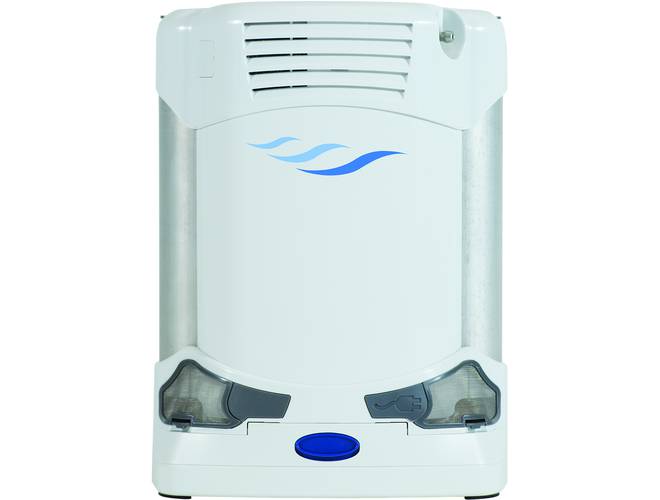
The FreeStyle Comfort’s most immediately distinctive quality is its physical design: its curved shell. While most POCs are rectangular or oval, CAIRE engineered the FreeStyle Comfort with a body-skimming contour that follows the natural curves of the hip and torso when the device hangs on a shoulder strap. In practical terms, this reduces the pendulum-like swinging that heavier rectangular devices exhibit during walking.
We realized that the FreeStyle Comfort’s ergonomic curve made a noticeable difference compared to the box-shaped units we’d previously evaluated. It sits against the hip rather than swinging away from it with each step, a small design detail that matters enormously over a full day of wear.
The device ships with a shoulder carry bag and can also be worn in an optional backpack, giving three carry configurations total, more than either Inogen Rove model. At 5.0 pounds with the standard 8-cell battery, it’s slightly heavier than the Inogen Rove 6 (4.8 lbs) but still light enough that most users forget they’re wearing it within a few minutes.
Smart Oxygen Delivery: autoSAT, autoDOSE, and UltraSense
The FreeStyle Comfort’s oxygen delivery system incorporates three proprietary CAIRE technologies. UltraSense is CAIRE’s breath detection algorithm, designed to detect breath onset quickly and reliably, even in patients with shallow or irregular breathing patterns.
autoSAT, now available on the FreeStyle Comfort in the U.S. as of October 2025, automatically adjusts the oxygen bolus delivered per breath based on the patient’s current breathing rate. When you walk faster, your breathing rate rises, and autoSAT increases the bolus volume to maintain consistent oxygen saturation. When you sit down, the delivery proportionally decreases.
The autoSat’s transition between seated rest and walking was seamless; the device adjusts without any prompting and without the slight lag on some competing units. A bench study published in Pulmonary Therapy found that the FreeStyle Comfort with autoSAT at 40 breaths per minute on setting 2 delivered a statistically higher FiO₂ than wall oxygen in controlled conditions.4
autoDOSE also addresses a specific safety gap: if the device detects no breath, it automatically delivers oxygen at 20 breaths per minute at the current setting, rather than waiting indefinitely.
The glow-in-the-dark keypad and large multi-color LCD display are practical accessibility features that stand out immediately in real use.
Battery Performance
The FreeStyle Comfort ships with an 8-cell battery providing up to 8 hours of runtime at setting 1. The optional 16-cell battery extends this to up to 16 hours at setting 1, the longest maximum battery life of any pulse dose portable oxygen concentrator currently on the U.S. market. Real-world performance at higher settings is lower: at settings 2 or 3, realistic runtime on the 16-cell battery is typically 8 to 12 hours, depending on activity level.
One limitation worth flagging: the FreeStyle Comfort can be used while charging from a wall outlet, but not while charging from a DC car adapter. This is a minor inconvenience for most users, but a meaningful distinction for anyone planning a long road trip on battery power alone.
Longevity Stat: A Respiratory Medicine review found that long-term oxygen therapy significantly reduces mortality in COPD patients with severe resting hypoxemia.5
Who is the CAIRE SeQual Eclipse 5 Best For?
The SeQual Eclipse 5 is fundamentally different from the FreeStyle Comfort. It is a cart-based, transportable concentrator, not a shoulder-carry portable, designed for users who require continuous-flow oxygen, higher pulse settings, or both. At 18.4 lbs with its battery and rolling cart, it is closer in practical use to wheeling a small piece of luggage than wearing a shoulder bag.
Its intended users are those with moderate to severe COPD whose prescriptions require continuous flow, patients who need oxygen while using CPAP or BiPAP at night, and patients with higher pulse-dose requirements (settings up to 9) that lighter devices cannot meet. Our dedicated guide on portable oxygen concentrators for COPD covers the clinical tradeoffs in detail.
We rank the Eclipse 5 high for usability, with its rolling cart and telescoping handle. It's easily adjustable with one hand, and the cart’s base is stable on minor surface irregularities. That said, its 18.4-pound total weight may make it challenging for some seniors to lift.
Continuous Flow and CPAP Compatibility
The Eclipse 5 delivers continuous-flow oxygen from 0.5 to 3.0 LPM in 0.5 LPM increments, covering the full range required for most continuous-flow prescriptions. This makes it compatible with CPAP and BiPAP machines through an inline adapter, making it a practical single-device solution for patients managing both COPD and obstructive sleep apnea. For patients considering portable oxygen for sleep apnea, the Eclipse 5 is the only CAIRE portable that meets CPAP oxygen needs.
Power Flexibility
The Eclipse 5 operates on AC wall power, DC car adapter, or battery, and can recharge its battery and deliver oxygen simultaneously while connected to DC power. This makes long road trips genuinely practical: the unit runs continuously in the car without consuming the battery, arriving at the destination with a fully charged pack.
Battery life at continuous flow settings is limited: approximately 2 hours at 2 LPM, approximately 1.3 hours at 3 LPM. We tested this in a simulated overnight setup and found that with the Eclipse 5 plugged in, oxygen delivery was seamless. The 48 dBA noise level is noticeable in a quiet bedroom but most users adapt to it quickly.
Altitude Performance
The Eclipse 5 is rated for operation at altitudes up to 13,123 feet, one of the highest altitude ratings of any portable concentrator currently on the market. For patients planning trips to high-altitude destinations, our guide to traveling with portable oxygen concentrators covers airline and altitude considerations in detail.
COPD Overlap Data: Research published in the International Journal of COPD found that 10%-15% of COPD patients also have obstructive sleep apnea (overlap syndrome), making CPAP-compatible oxygen concentrators like the Eclipse 5 particularly relevant for this population.6
myCAIRE App Review
The myCAIRE app is CAIRE’s telehealth companion solution for the FreeStyle Comfort, available for both iOS and Android. Its core functionality goes significantly beyond the device monitoring offered by Inogen Connect. Where Inogen Connect shows battery level and flow setting, myCAIRE shares usage data, flow rate history, and device notifications with the user’s care team in real time, enabling remote prescription oversight by a respiratory therapist or physician without requiring the individual to come into the office.
The app also includes the device manual and allows patients to request technical support directly from their provider through the interface. The Eclipse 5 uses a separate utility, eTask, that provides a clinical tool for estimating equivalent pulse-dose settings for a given continuous-flow prescription.
Compared to Inogen Connect, myCAIRE’s telehealth integration layer provides more clinical utility. Inogen Connect is simpler and more caregiver-focused. The right app depends on whether clinical remote monitoring matters to your care team, or whether real-time device status for a caregiver is the primary use case.
Add-On Features and Accessories
FreeStyle Comfort Accessories
- 16-cell extended battery: Extends runtime up to 16 hours at setting 1. Often sold separately from base packages and is the single most impactful add-on for extended travel days.
- Backpack carry case: Optional backpack-style carrier for hands-free wear; suited for walking, hiking, or shopping days.
- Carry bag: Standard shoulder-style bag included with the device.
- External battery charger: Allows independent charging of a spare battery while the device runs on another.
- Replacement cannulas and filters: Consumable supplies recommended for replacement per manufacturer guidelines.
SeQual Eclipse 5 Accessories
- Additional battery pack: Extends usable operating time away from wall or car power.
- External battery charger: Enables simultaneous device use and spare battery charging.
- Travel case and rain cover: Protective carry solutions for road and air travel.
- Humidifier adapter kit: Required for connecting a standard bubble humidifier bottle for continuous flow CPAP integration.
- Cart replacement and upgrade parts: Available through authorized service centers.
Warranty, Trial, and Support
Both the FreeStyle Comfort and the SeQual Eclipse 5 carry CAIRE’s standard warranty: three years covering the device AND sieve beds. Sieve bed replacement is the primary maintenance cost on any concentrator, typically running $300 to $500 at the end of warranty on other brands. CAIRE’s industry-first inclusion of sieve beds in the 3-year coverage window represents real long-term cost savings.
CAIRE vs. Inogen: Full Comparison
Unlike Inogen, CAIRE does not offer a direct-to-consumer lifetime warranty program. The 3-year coverage is the standard manufacturer term across both portable models. CAIRE also does not publish a standard consumer trial or return window, as purchases are routed through authorized dealers. Before committing to a purchase, confirm the dealer’s return and trial policy in writing.
Further, CAIRE does not provide a dedicated in-house Medicare insurance navigation team; coverage coordination happens through the patient’s chosen DME supplier. For seniors in metropolitan areas with established home health equipment suppliers, access to CAIRE products is generally straightforward. In rural areas with fewer suppliers, the path to a CAIRE device through insurance may require more effort.
When comparing CAIRE’s lineup to Inogen, the differences come down to specific priorities rather than one brand simply being better than the other.
- Battery life: The FreeStyle Comfort’s 16-cell battery (up to 16 hours at setting 1) meaningfully outperforms the Inogen Rove 6’s maximum of 12 hours 45 minutes. For patients who spend full days away from a power source, this difference is material.
- Weight: The Inogen Rove 4 (2.9 lbs) is dramatically lighter than any CAIRE portable. The Rove 6 (4.8 lbs) and FreeStyle Comfort (5.0 lbs) are comparable. If minimum weight is the top priority, the Rove 4 or Rove 6 wins.
- Oxygen output per pound: The Inogen Rove 6 delivers 1,260 mL/min at 4.8 lbs. The FreeStyle Comfort delivers 1,050 mL/min at 5.0 lbs. Inogen is more output-efficient by weight.
- Sieve bed warranty: CAIRE’s 3-year sieve bed inclusion is an industry first. Inogen units use user-replaceable sieve beds not covered under warranty. Over a 3-year period, this can represent $300 to $500 in savings.
- Medicare coordination: Inogen has a dedicated in-house Medicare navigation team. CAIRE routes patients to their DME supplier. For patients new to the oxygen therapy process, Inogen’s direct support can simplify an otherwise confusing coverage process.
- Telehealth: myCAIRE’s care team data-sharing goes further than Inogen Connect’s device status monitoring. For patients whose physicians want remote visibility into therapy adherence and dosing, CAIRE has a clear edge.
FYI: If you’re comparing the full range of brands before deciding, our overview of Inogen portable oxygen concentrators gives a direct comparison point.
Conclusion
CAIRE builds for clinical depth, not just lightweight — and it shows. The FreeStyle Comfort stands out with its ergonomic curved shell, industry-leading 16-hour battery, autoSAT smart delivery, and an industry-first 3-year sieve bed warranty. The myCAIRE telehealth app also provides care teams with real-time visibility that Inogen Connect simply doesn't offer. The trade-offs: a five-setting pulse-dose ceiling, no DC concurrent charging, and no in-house Medicare navigation.
The SeQual Eclipse 5 plays a different game entirely. For patients who need continuous flow, CPAP integration, or higher pulse settings on the road, it's in a category of its own.
Choosing between CAIRE and Inogen comes down to what matters most to you. Inogen wins on oxygen output per pound, lifetime warranty options, and direct Medicare support. CAIRE wins on battery life, ergonomics, telehealth integration, and sieve bed coverage.
Frequently Asked Questions
-
What is the difference between the CAIRE FreeStyle Comfort and the Eclipse 5?
The FreeStyle Comfort is a lightweight (5 lbs) shoulder-carry pulse dose unit, while the Eclipse 5 is a cart-based (18.4 lbs) unit with continuous flow up to 3 LPM. Choose the FreeStyle Comfort for active daily mobility; choose the Eclipse 5 if your prescription requires continuous flow or higher pulse settings.
-
How does CAIRE compare to Inogen for portable oxygen concentrators?
CAIRE leads on battery life (up to 16 hours vs. Inogen Rove 6’s 12 hrs 45 min), sieve bed warranty coverage, and telehealth integration. Inogen leads in oxygen output per pound, offers a lifetime warranty option, and provides direct Medicare navigation.
-
Does the CAIRE FreeStyle Comfort work with a CPAP machine?
No. The FreeStyle Comfort is a pulse-dose device and is not compatible with CPAP or BiPAP therapy. Patients who need CPAP-compatible oxygen should consider the SeQual Eclipse 5. See our guide on portable oxygen for sleep apnea for more context.
-
What is the myCAIRE app and how does it work?
myCAIRE is a telehealth companion app (iOS and Android) that shares real-time usage data and flow settings with the patient’s care team, enabling remote collaboration. It also includes the device manual and lets patients request service directly through the app, going further than the basic device-status monitoring offered by Inogen Connect.
-
Is the CAIRE SeQual Eclipse 5 FAA-approved for air travel?
Yes. The Eclipse 5 meets FAA acceptance criteria for U.S. commercial flights and its battery can be transported in the cabin. Due to its weight and cart, coordinate with your airline’s accessibility desk in advance.