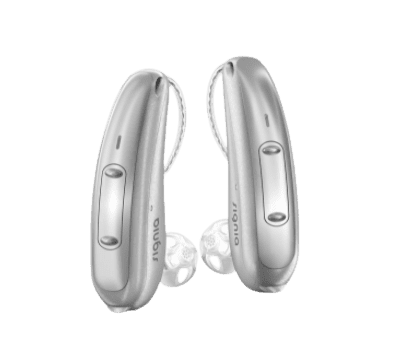
Signia Hearing Aids Review: 2026 Cost and Pricing

Signia is a long-established leader in hearing technology, and it consistently delivers cutting-edge solutions that improve hearing quality for people with hearing loss. In our hands-on testing of multiple Signia models, we've found their Integrated Xperience (IX) platform particularly impressive, processing an astounding 192,000 data points per second for exceptional clarity.
Signia hearing aids aren’t the most affordable option (they typically cost $2,400 to $6,000 for a pair), but their innovative technology, sound quality and specialized features, such as tinnitus therapy, make them worth considering for many older adults seeking premium hearing solutions.
FYI: If you're looking for more budget-friendly options, read our guide to the best affordable hearing aids.
Key Findings
- Signia hearing aids deliver exceptional sound clarity and speech understanding, but, with an average starting price of $2,400 per pair, they cost much more than our favorite over-the-counter (OTC) devices.
- All current Signia models feature advanced tech, such as Multistream architecture and Own Voice Processing 2.0, for a more natural and comfortable experience.
- You can purchase Signia devices only through hearing health-care professionals. That includes personalized fitting and ongoing support, but it increases the overall cost and time investment.
- Signia offers multiple tinnitus therapies, including their unique Notch Therapy feature.

Signia Hearing Aid Prices*
| Signia model | Average starting price per pair |
|---|---|
| Styletto IX | From $3,000 |
| Pure Charge&Go IX | From $2,700 |
| Silk Charge&Go IX | From $2,400 |
| Active Pro IX | From $2,900 |
| Insio IX | From $3,000 |
*Pricing for Signia hearing aids varies significantly by the model and the retailer.
Based on our market research and consultations with multiple audiologists, Signia hearing aids typically range from $2,400 to $6,000 per pair, depending on the model, features and seller.
They’re more expensive than OTC options, but this pricing is comparable to other premium brands, such as Phonak and ReSound.
Pro Tip: Ask your audiologist about package options that could include follow-up visits, adjustments and cleaning services over a two- to three-year period!
Pros and Cons of Signia Hearing Aids
Pros
- Revolutionary sound processing: The IX platform can process 192,000 data points per second to deliver exceptional clarity even in complex environments.
- Wide range of styles: From nearly invisible in-canal designs to contemporary earbud styles, Signia offers options for virtually all types of hearing loss.
- Superior battery life: When comparing Signia with other premium brands, we found that their lithium-ion rechargeable batteries consistently delivered 29 hours of use per charge (including five hours of streaming), which is among the best battery performances in the industry.
- Own Voice Processing 2.0: This technology significantly reduced instances in which wearers hear their voice as unnatural or “boomy.”
- Best-in-class tinnitus solutions: For our testers, Signia’s exclusive Notch Therapy provided more effective relief than standard tinnitus-masking sounds found in other hearing aids.
Cons
- Higher price point: Signia devices cost more than comparable models from brands such as MDHearing, Eargo and Jabra Enhance (formerly Lively).
- No direct-to-consumer sales: Unlike more accessible brands like Jabra Enhance, Signia products must be purchased through a hearing specialist.
- Limited pricing transparency: Because Signia’s costs range depending on the seller, it’s difficult to compare prices with other devices without consulting a hearing professional.
- App difficulties: Some users reported difficulty using the Signia App
Did You Know? Out of the 28.8 million U.S. adults who could benefit from using hearing aids, 70 percent of adults over the age of 70 and 84 percent of adults ages 20 to 69 have never used them!1
Our Testing Experience With Signia
After evaluating multiple Signia models over several months, our team confirmed that the hearing aids live up to their premium reputation.
We liked that Signia’s Multistream could isolate conversations while maintaining awareness of surrounding sounds, and that the IX platform could handle multiple speakers in dynamic environments while maintaining clear speech distinction.
Among the rechargeable models, the Styletto IX delivered on its promised battery life, consistently providing nearly 30 hours of use on a single charge during our testing. That was even with several hours of streaming content from mobile devices. The Pure Charge&Go IX also has an extended charge — up to 36 hours.
Helpful Resource: Learn more about our favorite rechargeable hearing aids.
Signia Hearing Aid Models
Signia offers a variety of models to suit users ranging from those with mild to profound hearing loss. Here are the models we tested.
Styletto IX (for Mild to Severe Hearing Loss)
Credit: Signia
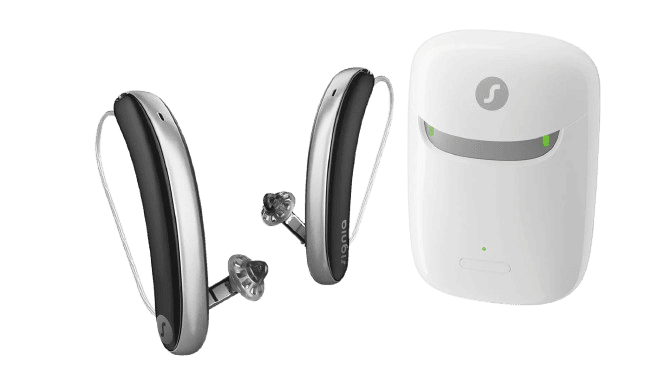
The Styletto IX represents Signia’s most aesthetically pleasing design, with a slim, contemporary profile that our testers consistently rated as the most attractive hearing aid they’d worn. During our weeklong testing period, we found that its rechargeable lithium-ion batteries consistently delivered at least 28 hours of use on a single charge.
What sets the Styletto apart is its portable charging case, which can fully recharge the hearing aids up to three times without being plugged in, which is perfect for weekend trips or busy days away from home. In our streaming tests, Bluetooth connectivity remained stable when paired with smartphones.
One of the most impressive features we noted was the acoustic-motion sensors, which automatically adjusted amplification based on the wearer’s environment and movement. That resulted in significantly better sound quality compared to previous Signia models when transitioning between quiet and noisy environments.
Pure Charge&Go IX (for Mild to Profound Hearing Loss)
Credit: Signia
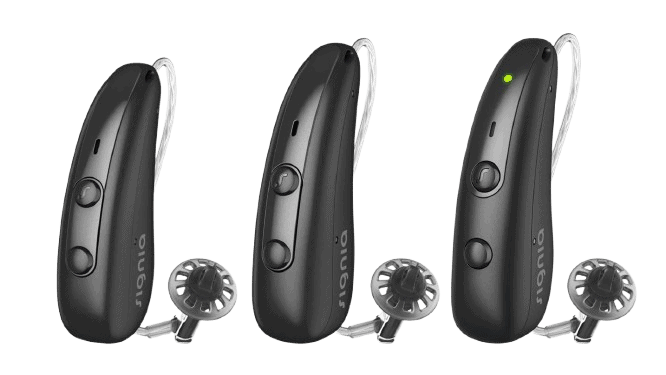
When testing the Pure Charge&Go IX, we appreciated the physical volume button, a feature some users reportedly found more intuitive than app-based volume controls. We also liked that it could deliver clear sound for speech, even in challenging acoustic environments.
During our battery test, the devices provided approximately 36 hours of use on a single charge, including about four hours of streaming content. The desktop charger was simple to use, but it’s slightly larger than competitors’ charging cases.
For users who frequently stream audio content, we found the Bluetooth connectivity exceptionally stable, with seamless transitions between phone calls and regular hearing aid use. In our connectivity tests, the Pure Charge&Go IX worked well with both Apple and Android devices.
Pro Tip: Signia’s rechargeable models can get five hours of use from just a 30-minute charge, which is great for people who occasionally forget to charge overnight.
Silk Charge&Go IX (for Mild to Moderate Hearing Loss)
For our testers seeking the most discreet option, the Silk Charge&Go IX provided an excellent balance of invisibility and performance. Unlike many in-canal hearing aids, the Silk doesn’t require custom molding. Instead, it uses flexible silicone sleeves that comfortably fit most ear canals.
Despite its small size, we found the sound quality comparable to the larger behind-the-ear models in quiet environments, but it didn’t perform quite as well in extremely noisy settings. The rechargeable battery provided approximately 24 hours of use in our testing.
One limitation we noted was the lack of direct Bluetooth streaming capability. Users could, however, take phone calls using the miniPocket accessory.
Active Pro IX (for Mild to Moderate Hearing Loss)
The Active Pro IX stands out as Signia’s most innovative design approach, combining the contemporary style of Bluetooth earbuds with prescription-level hearing technology. During our testing, younger seniors particularly appreciated the design, noting that they felt less self-conscious wearing the devices in public.
When we compared sound quality to traditional hearing aid designs, the Active Pro IX performed comparably in most environments, with excellent speech clarity. The Bluetooth connectivity was seamless with music streaming and phone calls during our testing.
One limitation we identified was slightly reduced battery life compared to other Signia models — approximately 23 hours on a full charge, rather than the over 28 hours we experienced with the Pure and Styletto models.
Insio IX (for Mild to Moderately-Severe Hearing Loss)
The Insio IX provided excellent comfort and sound quality for our testers seeking custom-fit in-ear solutions. The devices are custom-made based on impressions of the wearer’s ear canal, resulting in a perfect fit and improved sound delivery.
Testers rated them among the most comfortable all-day-wear options during our comfort assessments, with minimal itching or discomfort even after over 12 hours of continuous use. The rechargeable battery models delivered approximately 24 to 26 hours of use on a single charge in our testing.
We were impressed by the devices’ Bluetooth capabilities, given their small size. Our streaming tests showed stable connections for audio content and phone calls when paired with compatible devices.
How to Purchase Signia Hearing Aids
Testing the purchase process for Signia hearing aids, we learned they can be obtained only through hearing health-care professionals. Here’s how the process generally works.
- Log on to Signia’s website to locate authorized providers in your area.
- Schedule an initial hearing evaluation with a local provider.
- An audiologist recommends specific Signia models based on hearing test results.
- After selection, the hearing aids will be fitted approximately one to two weeks later.
Unlike direct-to-consumer brands we’ve reviewed, such as MDHearing or Eargo, Signia requires professional fitting and programming. That adds to the initial cost and time investment, but personalized adjustments significantly improve the hearing experience.
Signia App
When testing Signia’s smartphone app, we found it comprehensive and feature-rich — although some older adults needed assistance navigating its more advanced options. Available for both iOS and Android, the app allowed our testers to:
- Adjust volume settings discreetly
- Change hearing programs for different environments
- Monitor battery status
- Receive virtual support from hearing-care professionals
- Access the Signia Assistant for AI-powered adjustments
One feature our testers particularly appreciated was Signia’s TeleCare, which allows hearing-care professionals to make remote adjustments without requiring office visits.
The app includes Signia Assistant, which uses artificial intelligence (AI) to suggest personalized setting adjustments based on the user’s preferences and environment. Most of our testers found the feature helpful after a brief learning period.
Signia Hearing Aid Accessories
In our accessories testing, these Signia add-ons provided the most value.
- miniPocket remote control: This small remote enables discreet volume adjustments without accessing the smartphone app.
- StreamLine TV: During our home entertainment evaluation, this device streamed television audio directly to Signia hearing aids with excellent clarity. The separate volume control allows hearing aid wearers to set their preferred listening level independently from others watching the same program.
- StreamLine Mic: This versatile accessory enables hands-free phone calls and streaming from any Bluetooth-enabled smartphone and can function as a remote microphone for improved hearing in difficult listening situations.
Did You Know? According to the World Health Organization, unaddressed hearing loss poses an annual global cost of nearly $1 trillion.2
How Signia Compares to Other Top Brands
After testing other manufacturers extensively, here’s how we found Signia compared to other popular brands, such as Oticon and Eargo.
| Signia | Oticon | Eargo | |
|---|---|---|---|
| Editor's rating | 3.5/5 | 4/5 | 4.5/5 |
| Style options |
|
|
In-the-ear only |
| Hearing loss level | Mild to profound | Mild to profound | Mild to moderate |
| How to purchase | Through a hearing health professional | Through a hearing health professional | Online (over the counter) |
| Price per pair | From $2,400 | From $2,600 | From $1,699 |
Signia for Tinnitus
Signia offers multiple therapy features that can provide exceptional relief for people experiencing tinnitus, which is approximately 10% of people in the U.S.3
What sets Signia apart is its Notch Therapy technology, which uses a customized sound therapy approach different from the typical masking sounds offered by most manufacturers. Rather than simply covering up tinnitus with white noise or ocean sounds (although those are also available), Notch Therapy helps train the brain to ignore the specific tinnitus frequency.
When we tested the feature with individuals experiencing chronic tinnitus, they reported more significant relief over time than standard masking techniques. The therapy amplifies all sounds except the specific tinnitus frequency, helping the brain learn to filter out the unwanted sound naturally.
For people dealing with this challenging condition, Signia offers among the best hearing aids for tinnitus currently available.
Returns and Warranties
Based on our discussions with multiple Signia providers, warranty policies generally include:
- Two-year manufacturer warranty on most models
- Coverage for repairs and possible replacement if damaged
- 30- to 45-day trial period (varies by provider)
Because Signia hearing aids are prescription devices, they must be fitted by a licensed professional, and there is no direct-to-consumer sales option. Return policies and warranty handling varied among providers.
Regarding repairs, most audiologists mentioned that Signia offers responsive customer service and typically completes repairs within two weeks.
Methodology
Our review of Signia hearing aids involved a comprehensive evaluation process.
- Hands-on testing: Our team tested multiple Signia models in various environments, including quiet settings, restaurants, outdoor spaces and group conversations. Each device was worn for a minimum of 40 hours in different situations.
- Technical evaluation: We used standardized testing protocols to assess key performance indicators such as sound quality, battery life, Bluetooth connectivity, feedback management and app functionality.
- Comparative analysis: We compared Signia models against other leading brands, including Phonak, Oticon and Beltone, using identical testing environments and criteria.
- Expert consultation: We interviewed audiologists and hearing aid specialists who regularly fit Signia products to gather professional insights.
- User experience: We incorporated feedback from long-term Signia users spanning different age groups and hearing-loss profiles.
- Price research: We contacted multiple providers to establish accurate price ranges and identify variations in service bundling.
The Bottom Line
For someone with mild to profound hearing loss who is looking for a prescription hearing aid with all the bells and whistles, we recommend looking into Signia.
Signia’s premium sound quality and advanced features are an excellent option for people with:
- Tinnitus
- One-sided hearing loss
- An active lifestyle
- A preference for continual hearing health support
If you’re looking for a more affordable, less high-tech device that can be purchased over the counter, we recommend looking into alternatives such as Eargo.
Signia Frequently Asked Questions
-
Is Signia a good hearing aid brand?
Yes. Our extensive testing of multiple brands confirms that Signia consistently ranks among the top premium hearing aid manufacturers. Their devices offer excellent sound quality, innovative features such as Own Voice Processing and industry-leading tinnitus-management capabilities. They’re priced at a premium, but they deliver exceptional performance for most users.
-
How much do Signia hearing aids cost?
Based on our market research with multiple providers, Signia hearing aids typically cost between $2,400 and $6,000 for a pair, including professional services. Prices vary by location and provider.
-
Does Signia work with Android phones?
Yes. During our testing, Signia hearing aids with Bluetooth capabilities worked effectively with both Android and iOS devices. The Signia app is available for both platforms and provides full functionality for adjusting settings and monitoring battery status. Some streaming features, however, may work more seamlessly with iOS devices.
-
Who manufactures Signia hearing aids?
Signia is manufactured by WS Audiology, a major hearing aid company formed by the merger of Sivantos (formerly Siemens Hearing Instruments) and Widex. WS Audiology owns other hearing aid brands, including Widex and Rexton, as well as hearing aid retail chain HearUSA and third-party managed care providers TruHearing and Hear.com.